

Dua · Home
Rabbana Atina Fid Dunya Hasanah Full Audio Arabic Dua Urdu Translation
by Mishary Rashid Alafasy
Audio Details
Important Notes About This Audio
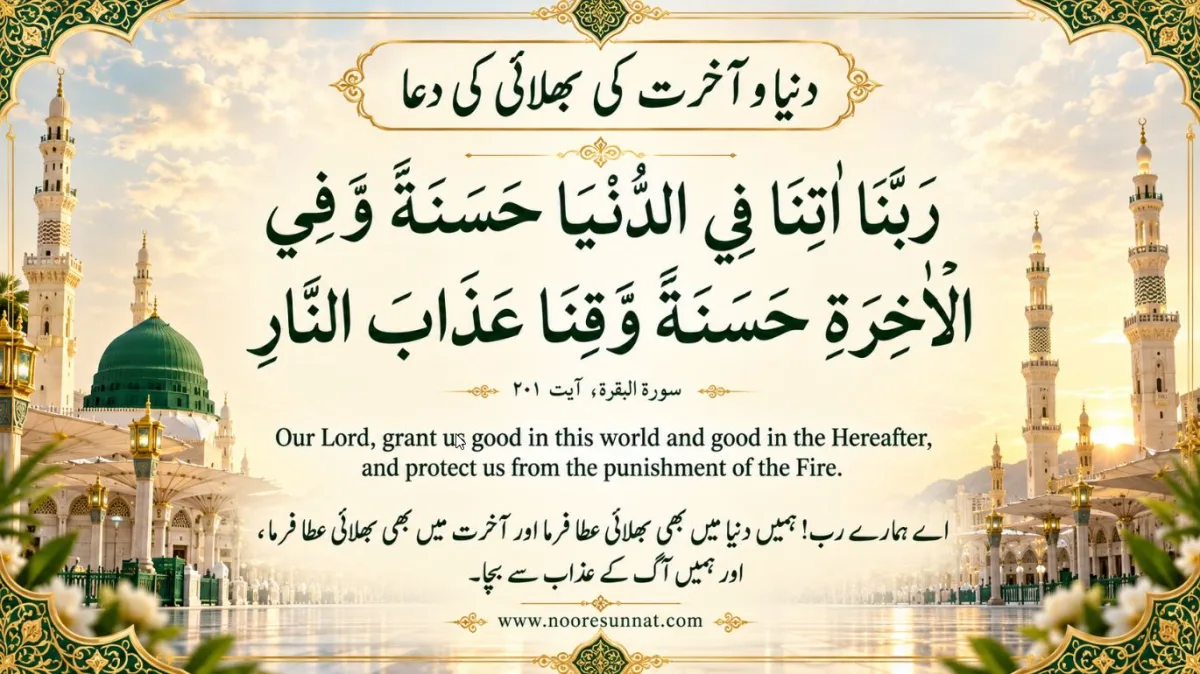
Rabbana Atina Fid Dunya Hasanah (Duniya Aur Akhirat Ki Bhalai Ki Dua)
Arabic Text
رَبَّنَا آتِنَا فِي الدُّنْيَا حَسَنَةً وَفِي الْآخِرَةِ حَسَنَةً وَقِنَا عَذَابَ النَّارِ
Urdu Translation
اے ہمارے رب! ہمیں دنیا میں بھی بھلائی عطا فرما اور آخرت میں بھی بھلائی عطا فرما، اور ہمیں آگ کے عذاب سے بچا۔
English Translation
Our Lord, grant us good in this world and good in the Hereafter, and protect us from the punishment of the Fire.
Transliteration
Rabbanaa aatinaa fid-dunyaa hasanatan wa fil-aakhirati hasanatan wa qinaa ‘adhaaban-naar.
Where Does This Dua Come From?
This dua appears in Surah Al-Baqarah, verse 201. Allah presents it as the supplication of those who ask for goodness in both this life and the Hereafter.
The surrounding verses discuss remembering Allah after completing the rituals of Hajj. They describe people who ask only for worldly benefits, followed by those whose prayers include the Hereafter and protection from the Fire. This dua expresses that broader concern.
Quran reference: Surah Al-Baqarah 2:201 on Quran.com
Who Recited This Dua?
Prophet Muhammad ﷺ recited this supplication frequently. Anas ibn Malik رضي الله عنه reported that it was the Prophet’s ﷺ most frequent dua.
The wording in this narration begins with “Allaahumma Rabbanaa”, meaning “O Allah, our Lord,” before continuing with the same requests for goodness in this world, goodness in the Hereafter, and protection from the Fire.
Hadith reference: Sahih al-Bukhari 6389 on Sunnah.com
What Does This Dua Mean?
This short supplication contains three requests that help us reflect on our needs and our final destination.
“Rabbanaa aatinaa fid-dunyaa hasanah” — Our Lord, grant us good in this world
We ask Allah for goodness during our earthly lives. The wording leaves the request broad rather than naming just one particular blessing.
When reciting it, we can bring to mind our need for faith, lawful provision, health, beneficial knowledge, good character, and a peaceful family life. We ask Allah to grant what is truly good for us.
“Wa fil-aakhirati hasanah” — And good in the Hereafter
We also ask for goodness in the life to come. This turns our attention towards forgiveness, Allah’s pleasure, and Paradise.
It reminds us to consider how our choices today affect our eternal future.
“Wa qinaa ‘adhaaban-naar” — And protect us from the punishment of the Fire
The dua ends with a direct request for protection from Hellfire. These words express our dependence on Allah’s mercy and our need for His forgiveness.
As a practical reflection, this request should encourage us to repent, fulfil our obligations, and turn away from actions that displease Allah.
What Is the Wisdom of This Dua?
One lesson we can draw from its wording is that we may ask Allah for a good worldly life while keeping the Hereafter firmly in view. Our everyday needs have a place in our prayers, alongside our hope for eternal success.
The word “Rabbanaa,” meaning “our Lord,” also makes this a prayer in the plural. We ask for goodness for ourselves and others.
Its few words give us a broad supplication to return to throughout life. Whether our immediate concern is family, work, health, or our spiritual condition, we can ask Allah for goodness while trusting His knowledge of what will benefit us.
When Can You Recite It?
You can include this dua in your daily supplications and recite it whenever you ask Allah for goodness in this life and the next. Although it appears in the Quran’s discussion of Hajj, the Prophet’s ﷺ frequent use of it shows its place in everyday prayer.
Recite it thoughtfully, with its three requests in mind: goodness in this world, goodness in the Hereafter, and protection from the Fire.
About the Scholar
Mishary Rashid Alafasy
Shaykh Mishari Rashid Al Afasy is one of the world\'s most popular Quran Reciters. His melodious voice and impeccable tajweed are perfect for any student of Quran looking to learn the correct recitation of the holy book. Our website has a dedicated Mishari Rashid Recitation page with the complete Quran. You can also listen to this recitation along with Urdu translation by Mufti Taqi Usmani.
Full Quran RecitationHave a question or thought about this bayan?
Leave a comment below. All comments are reviewed before appearing.
Related Reading
-
Muslim Worldview - How a Muslim Sees the World
Who am I? Why am I here? What is right and wrong? What happens when I die? Islam has precise, coherent answers to all of these.
-
Islamic Beliefs — Aqeedah
The six pillars of Iman and the core beliefs every Muslim must hold.
-
The Five Pillars of Islam
Kalma, Namaz, Roza, Zakat, and Hajj — the foundations of Islamic practice.
Popular by Mishary Rashid Alafasy
- Ayat e Karima Wazifa Audio - La Ilaha Illa Anta Subhanaka 70,575 listeners
- Complete Ayat ul Kursi Audio Recitation With Urdu Hindi Translation 64,439 listeners
- Recitation Surah Fatiha 63,247 listeners
- Recitation Surah Baqarah 40,988 listeners
- Surah Baqarah Last 2 Ayat Amana Rasul Urdu Translation-Audio MP3 28,164 listeners
- Recitation Surah Ya-Seen 22,265 listeners