

Zikr · Home
Rabbi Jalni Muqimas Salati - Full Dua Audio With Urdu Tarjuma
by Mishary Rashid Alafasy
Audio Details
Important Notes About This Audio
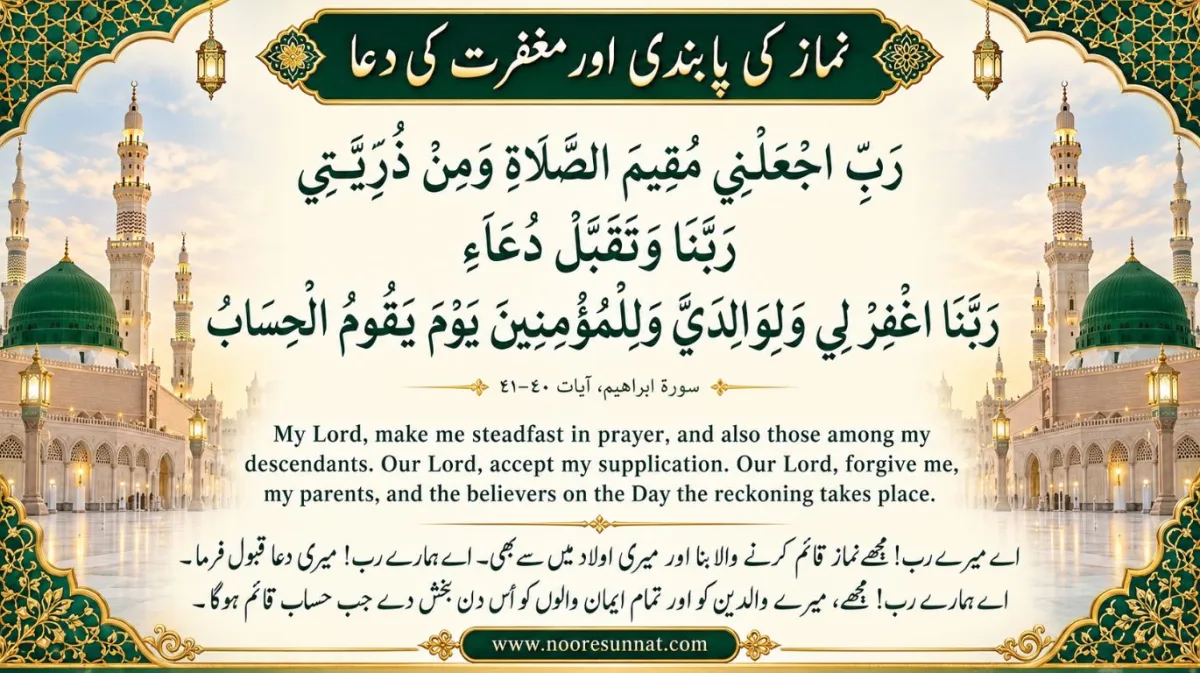
Rabbi Jalni Muqimas Salati Full Dua (Namaz Ki Pabandi Aur Maghfirat Ki Dua)
Arabic Text
رَبِّ اجْعَلْنِي مُقِيمَ الصَّلَاةِ وَمِنْ ذُرِّيَّتِي ۚ رَبَّنَا وَتَقَبَّلْ دُعَاءِ
رَبَّنَا اغْفِرْ لِي وَلِوَالِدَيَّ وَلِلْمُؤْمِنِينَ يَوْمَ يَقُومُ الْحِسَابُ
Urdu Translation
اے میرے رب! مجھے نماز قائم کرنے والا بنا اور میری اولاد میں سے بھی۔ اے ہمارے رب! میری دعا قبول فرما۔
اے ہمارے رب! مجھے، میرے والدین کو اور تمام ایمان والوں کو اُس دن بخش دے جب حساب قائم ہوگا۔
English Translation
My Lord, make me one who establishes prayer, and also some of my descendants. Our Lord, accept my supplication.
Our Lord, forgive me, my parents, and the believers on the Day the reckoning takes place.
Transliteration
Rabbij‘alnee muqeemas-salaati wa min dhurriyyatee, Rabbanaa wa taqabbal du‘aa’.
Rabbanaghfir lee wa liwaalidayya wa lil-mu’mineena yawma yaqoomul-hisaab.
Who Made This Dua?
This dua comes from Prophet Ibrahim عليه السلام and appears in Surah Ibrahim, verses 40–41. It brings together requests for steadfastness in prayer, righteousness among his descendants, acceptance of his supplication, and forgiveness for himself, his parents, and the believers.
Original Quran references: Surah Ibrahim 14:40 and Surah Ibrahim 14:41.
Background of the Dua
These verses form part of a longer passage recording Ibrahim’s عليه السلام supplications. He asks Allah to make Makkah secure, protect him and his children from idol worship, and provide for the family he settled near the Sacred House.
Immediately before this dua, he thanks Allah for blessing him with Ismail and Ishaq عليهما السلام in his old age. He then asks for a family legacy rooted in prayer and seeks Allah’s forgiveness for the Day of Reckoning.
Meaning and Explanation
The dua moves from personal worship to concern for family and the wider community of believers.
“Rabbij‘alnee muqeemas-salaati” — My Lord, make me one who establishes prayer
Ibrahim عليه السلام begins with himself. He asks Allah for the ability to maintain salah faithfully.
For us, these words are a reminder to seek Allah’s help with our worship and take practical steps to pray regularly, on time, and with attention.
“Wa min dhurriyyatee” — And also some of my descendants
The prayer extends to his children and future generations. The word dhurriyyah includes descendants, while min means “from” or “among.”
Parents can recite these words with hope for their children’s relationship with Allah. They also invite us to think about the example we set through our own prayers and conduct.
“Rabbanaa wa taqabbal du‘aa’” — Our Lord, accept my supplication
Ibrahim عليه السلام asks Allah to accept his prayer. This expresses humility and dependence on Allah’s mercy.
“Rabbanaghfir lee wa liwaalidayya wa lil-mu’mineen” — Our Lord, forgive me, my parents, and the believers
The second verse broadens the supplication further. It includes oneself, one’s parents, and the community of believers in a request for forgiveness.
A lesson we can draw is to remember others when making dua. Alongside our personal needs, we can ask Allah to show mercy to our families and fellow believers.
“Yawma yaqoomul-hisaab” — On the Day the reckoning takes place
The final words refer to the Day of Judgment. They remind us of our accountability before Allah and our need for His forgiveness.
Lessons From This Dua
This supplication encourages us to make prayer a lasting part of our lives, care about the faith of future generations, and remember our parents and fellow believers.
It also connects our daily actions with the Hereafter. We ask for help with worship now and forgiveness when we stand before Allah.
For parents, a practical way to live by its meaning is to combine dua with patient teaching, gentle encouragement, and a consistent example of salah at home.
When Can You Recite It?
You can include these verses in your daily supplications, especially when praying for steadfastness in salah, your children’s faith, and forgiveness for yourself and your family.
These verses do not prescribe a specific repetition count. Recite them with understanding and sincerity, while working towards the qualities you ask Allah to grant.
About the Scholar
Mishary Rashid Alafasy
Shaykh Mishari Rashid Al Afasy is one of the world\'s most popular Quran Reciters. His melodious voice and impeccable tajweed are perfect for any student of Quran looking to learn the correct recitation of the holy book. Our website has a dedicated Mishari Rashid Recitation page with the complete Quran. You can also listen to this recitation along with Urdu translation by Mufti Taqi Usmani.
Full Quran RecitationHave a question or thought about this bayan?
Leave a comment below. All comments are reviewed before appearing.
Related Reading
Popular by Mishary Rashid Alafasy
- Ayat e Karima Wazifa Audio - La Ilaha Illa Anta Subhanaka 70,575 listeners
- Complete Ayat ul Kursi Audio Recitation With Urdu Hindi Translation 64,439 listeners
- Recitation Surah Fatiha 63,247 listeners
- Recitation Surah Baqarah 40,988 listeners
- Surah Baqarah Last 2 Ayat Amana Rasul Urdu Translation-Audio MP3 28,164 listeners
- Recitation Surah Ya-Seen 22,265 listeners