
Zikr · Makkah Mukarrama
Hajj and Umrah Talbiyah - Labbaik Allahumma Labbaik Audio MP3 (Translation)
Audio Details
Important Notes About This Audio
Hajj and Umrah Talbiyah with Translation (Audio MP3)
The Talbiyah is the call every pilgrim recites during Hajj and Umrah after entering Ihram. It is a direct response to Allah’s invitation to visit His House. With every “Labbayk,” a believer expresses submission, love, and readiness to obey Allah.
Arabic Text (Talbiyah)
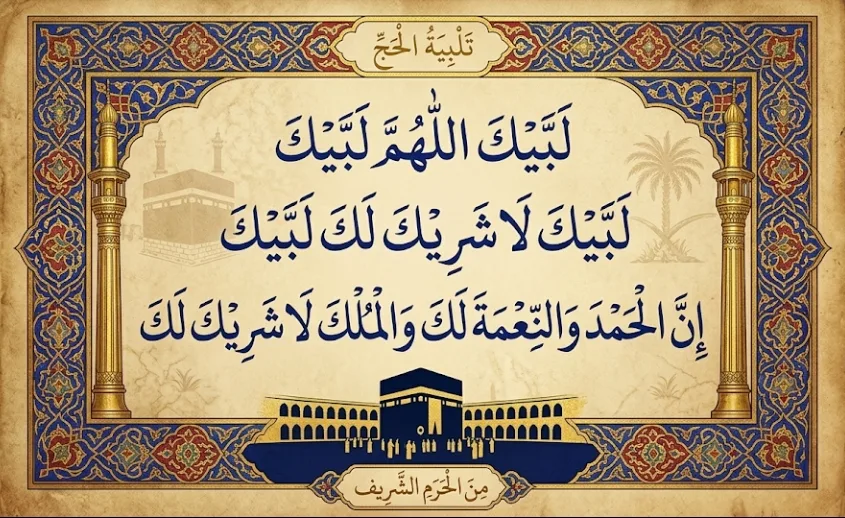
لَبَّيْكَ اللَّهُمَّ لَبَّيْكَ، لَبَّيْكَ لَا شَرِيكَ لَكَ لَبَّيْكَ، إِنَّ الْحَمْدَ وَالنِّعْمَةَ لَكَ وَالْمُلْك، لَا شَرِيكَ لَكَ
Transliteration
Labbayk Allahumma labbayk, labbayka la sharika laka labbayk, innal-hamda wan-ni‘mata laka wal-mulk, la sharika lak.
English Translation
Here I am, O Allah, here I am. Here I am, You have no partner, here I am. Surely all praise, blessings, and dominion belong to You. You have no partner.
Urdu Translation
میں حاضر ہوں اے اللہ! میں حاضر ہوں، میں حاضر ہوں، تیرا کوئی شریک نہیں، میں حاضر ہوں۔ بے شک تمام تعریفیں، نعمتیں اور بادشاہی تیرے ہی لیے ہیں، تیرا کوئی شریک نہیں۔
What Does the Talbiyah is Hajj & Umrah Mean? Detailed Explanation
The Talbiyah is not just a ritual phrase—it carries a deep historical and spiritual meaning that connects every pilgrim to the legacy of Hazrat Ibrahim (علیہ السلام).
When he completed the construction of the Ka‘bah, Allah commanded him to call people towards Hajj. Ibrahim (AS) wondered how his voice would reach everyone, but Allah assured him that He would deliver the message. Ibrahim (AS) made the call, and every soul destined to perform Hajj responded with “Labbayk.”
So when a pilgrim recites the Talbiyah today, it is not a new statement—it is a continuation of that original response. You are answering a call that was made long before your birth.
At its core, the word “Labbayk” reflects complete submission and readiness. It means more than just “I am here.” It carries a deeper sense of obedience and commitment:
- I am حاضر before You
- I am ready to obey You
- I will return to You again and again
- I accept Your command fully
This is why Talbiyah feels powerful. It is not just spoken—it is lived.
The Talbiyah also strongly emphasizes Tawheed (the oneness of Allah). The repeated phrase “La sharika lak” (You have no partner) removes every form of association with Allah.
Even before Islam, people used to recite a version of Talbiyah, but they added incorrect words that included shirk. The Prophet ﷺ corrected this and taught the pure form that Muslims recite today.
This makes Talbiyah a clear declaration of belief:
- Allah alone deserves worship
- No partner, no equal, no association
Another important part of the Talbiyah is the acknowledgment that everything belongs to Allah. When you say:
“Innal-hamda wan-ni‘mata laka wal-mulk”
you are admitting that:
- All praise belongs to Allah
- Every blessing comes from Him
- All ملك (power, control, and authority) is His
This shifts your mindset completely. You stop seeing yourself as the owner of anything and start seeing yourself as a servant.
Talbiyah is also meant to be repeated frequently during Hajj. This constant repetition is not without purpose. It keeps the heart focused and prevents distractions from taking over. Instead of getting lost in the physical journey, the pilgrim stays spiritually connected.
Through this repetition:
- The heart remains engaged with Allah
- The intention stays pure
- The entire journey becomes an act of worship
Finally, Talbiyah creates a powerful sense of equality and humility. Every pilgrim, regardless of wealth or status, wears the same Ihram and recites the same words. There is no distinction between people—only their connection with Allah matters.
In simple terms, Talbiyah is your declaration that:
- You heard Allah’s call
- You accepted it
- You left everything behind
- You came only for Him
And every time you say “Labbayk”, you renew that commitment.
Comments
Mohmad Ali
25 May 2026
Masha Allah highly informative .
Have a question or thought about this bayan?
Leave a comment below. All comments are reviewed before appearing.
Related Reading
-
Hajj — The Pilgrimage to Makkah
What Hajj is, who must perform it, the Day of Arafah, and why it is the greatest journey a Muslim can make.
-
Tauheed — The Oneness of Allah
What Tauheed means, Shirk, and La ilaha illallah explained.
-
The Five Pillars of Islam
Kalma, Namaz, Roza, Zakat, and Hajj — the foundations of Islamic practice.
Popular Audios
- Durood e Ibrahimi - The Best Darood Sharif (Urdu & Eng Translation) 123,034 listeners
- Eid ul Fitr & Adha Takbeer Full | Allahu Akbar Kabira MP3 Audio 111,763 listeners
- Takbeer e Tashreeq Audio (9 to 13 Zul Hijjah) 23,988 listeners
- Dua for Anxiety, Depression, Debt Relief - Allahumma inni auzubika minal hammi wal hazan 19,695 listeners
- Dua After Azan With English and Urdu Translation 16,361 listeners
- 4th (fourth) kalma audio with english and urdu translation 15,267 listeners