

Audio Details
Important Notes About This Audio
Second Kalima (Kalma e Shahadah) with Translation
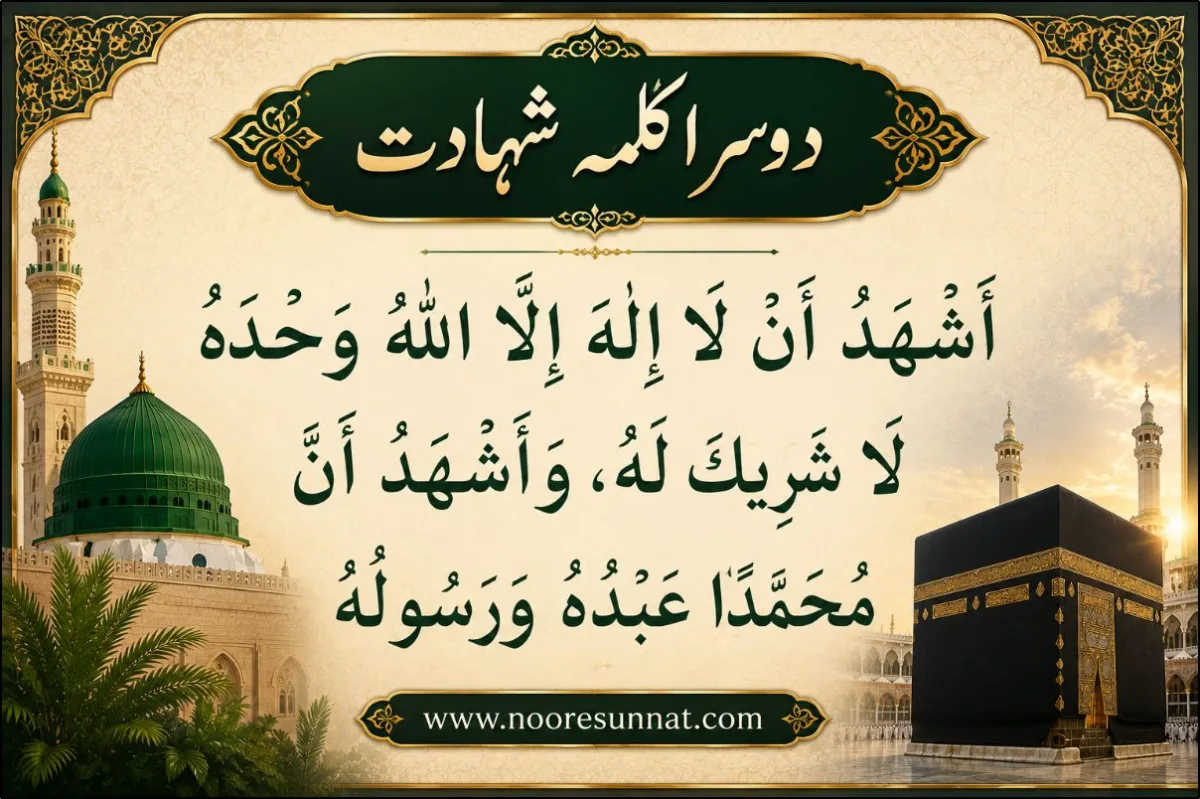
Dusra Kalma Arabic
أَشْهَدُ أَنْ لَّا إِلٰهَ إِلَّا اللّٰهُ وَحْدَهُ لَا شَرِيكَ لَهُ، وَأَشْهَدُ أَنَّ مُحَمَّدًا عَبْدُهُ وَرَسُولُهُ
Transliteration
Ashhadu an lā ilāha illallāhu waḥdahū lā sharīka lah, wa ashhadu anna Muḥammadan ‘abduhū wa rasūluh.
Urdu Translation
میں گواہی دیتا ہوں کہ اللّٰہ کے سوا کوئی عبادت کے لائق نہیں، وہ اکیلا ہے، اس کا کوئی شریک نہیں، اور میں گواہی دیتا ہوں کہ حضرت محمد ﷺ اللّٰہ کے بندے اور اس کے رسول ہیں۔
2nd Kalima English Translation
I bear witness that there is no one worthy of worship except Allah alone. He has no partner. And I bear witness that Muhammad ﷺ is His devoted worshipper and His Messenger.
Explanation of the Second Kalima
The Second Kalima is known as Kalima Shahadah, meaning the declaration of faith and testimony. It is the foundation of Islam and the statement through which a person enters Islam. This Kalima contains the two most important beliefs of a Muslim: belief in the oneness of Allah and belief in the prophethood of Muhammad ﷺ.
The words “Ashhadu an lā ilāha illallāh” mean “I bear witness that there is no god worthy of worship except Allah.” This is not just a sentence spoken by the tongue. It is a testimony from the heart that Allah alone deserves worship, obedience, love, hope, and fear in the highest sense. A Muslim believes that no idol, person, saint, worldly system, or desire can share the rights of Allah.
The phrase “Waḥdahū lā sharīka lah” strengthens this belief by declaring that Allah has no partner at all. He alone created the universe, controls every affair, provides sustenance, gives life, causes death, and deserves worship. Islam teaches pure Tawheed, meaning complete belief in the oneness of Allah without associating anyone with Him.
The second part of the Kalima says: “Wa ashhadu anna Muḥammadan ‘abduhū wa rasūluh.” Here, a Muslim testifies that Muhammad ﷺ is both the humble and devoted servant and Messenger of Allah. Calling him the servant of Allah protects people from exaggerating his status, while calling him the Messenger of Allah establishes his honor, truthfulness, and authority.
A Muslim believes that Rasulullah ﷺ conveyed Allah’s message perfectly and that true success lies in following his teachings and example.
This Kalima also teaches balance. Muslims deeply love and honor Rasulullah ﷺ, but they worship only Allah. The Prophet ﷺ himself taught humility and always directed people toward worshipping Allah alone.
Virtues of the Second Kalima
The Second Kalima is the greatest declaration a person can make because it is the key to Islam and the foundation of salvation. A person becomes a Muslim by sincerely believing and declaring this testimony. Without this belief, no عبادت or good deed has true value in the sight of Allah.
Rasulullah ﷺ taught that whoever sincerely says “Lā ilāha illallāh” with truthfulness from the heart will enter Jannah. Many ahadith mention the immense virtue of this testimony because it represents sincere faith, Tawheed, and submission to Allah.
This Kalima is also connected with forgiveness. The Prophet ﷺ taught that even if a person comes with many sins, sincere Tawheed and true faith in Allah can become a means of Allah’s mercy and forgiveness. However, this requires genuine belief and sincere repentance, not merely words spoken without faith or action.
The declaration of faith is also heavily connected to the remembrance of Allah. The Prophet ﷺ described the best form of dhikr as the declaration of Tawheed. These words purify the heart, increase iman, and remind a person about the real purpose of life.
The Second Kalima is recited throughout a Muslim’s life. It is recited in salah, adhan, dua, and many forms of worship. It is also encouraged that a believer’s final words before death should be “Lā ilāha illallāh.” Rasulullah ﷺ taught Muslims to encourage dying people to recite these blessed words because they are the words of faith and salvation.
This Kalima is not only a statement to memorize. It is a lifelong commitment to worship Allah alone and follow the guidance brought by Rasulullah ﷺ in every part of life.
Related Links
- Kalima e Tayyiba - the Foundation of Islam
- 1st (Pehla) Kalma Audio With Translation
- Dusra Kalma Shahadat - Audio MP3
- 3rd (Teesra) Kalima Audio With Translation
- 4th Kalima Audio With Translation
- 5th Kalima Audio with Translation
- 6th Kalima Audio With Translation
Have a question or thought about this bayan?
Leave a comment below. All comments are reviewed before appearing.
Related Reading
-
Kalma Shahada
The declaration of faith — La ilaha illallah Muhammadur Rasulullah.
-
Tauheed — The Oneness of Allah
What Tauheed means, Shirk, and La ilaha illallah explained.
-
Iman e Mujmal and Iman e Mufassal
The two declarations of Islamic faith explained word by word.
-
The Five Pillars of Islam
Kalma, Namaz, Roza, Zakat, and Hajj — the foundations of Islamic practice.
Popular Audios
- Durood e Ibrahimi - The Best Darood Sharif (Urdu & Eng Translation) 124,495 listeners
- Eid ul Fitr & Adha Takbeer Full | Allahu Akbar Kabira MP3 Audio 112,490 listeners
- Hajj and Umrah Talbiyah - Labbaik Allahumma Labbaik Audio MP3 (Translation) 73,054 listeners
- Takbeer e Tashreeq Audio (9 to 13 Zul Hijjah) 24,169 listeners
- Dua for Anxiety, Depression, Debt Relief - Allahumma inni auzubika minal hammi wal hazan 22,448 listeners
- 4th (fourth) kalma audio with english and urdu translation 18,393 listeners