
Zikr · Jamia Masjid Bait-ul-Mukkaram, Karachi
4th (fourth) kalma audio with english and urdu translation
Audio Details
Important Notes About This Audio
Fourth Kalima (Chotha Kalma Tawheed)with Translation
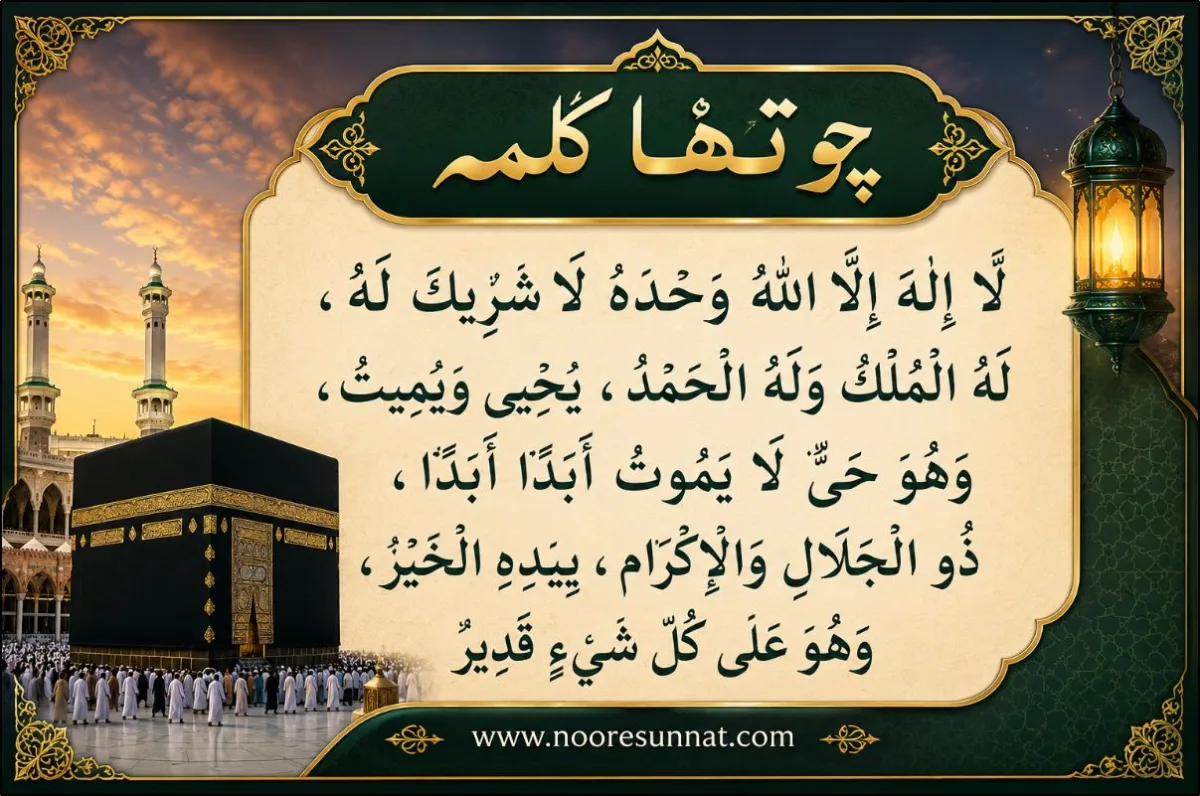
4th Kalma Arabic
لَا إِلٰهَ إِلَّا اللّٰهُ وَحْدَهُ لَا شَرِيكَ لَهُ، لَهُ الْمُلْكُ وَلَهُ الْحَمْدُ، يُحْيِي وَيُمِيتُ، وَهُوَ حَيٌّ لَّا يَمُوتُ أَبَدًا أَبَدًا، ذُو الْجَلَالِ وَالْإِكْرَامِ، بِيَدِهِ الْخَيْرُ، وَهُوَ عَلَى كُلِّ شَيْءٍ قَدِيرٌ
Transliteration
Lā ilāha illallāhu waḥdahū lā sharīka lah, lahul mulku wa lahul ḥamd, yuḥyī wa yumīt, wa huwa ḥayyul lā yamūtu abadan abada, dhul jalāli wal ikrām, biyadihil khayr, wa huwa ‘alā kulli shay’in qadīr.
Chotha Kalima Urdu Translation
اللّٰہ کے سوا کوئی عبادت کے لائق نہیں، وہ اکیلا ہے، اس کا کوئی شریک نہیں۔
اسی کی بادشاہی ہے اور اسی کے لیے تمام تعریفیں ہیں۔
وہی زندگی دیتا ہے اور وہی موت دیتا ہے۔
اور وہ ہمیشہ زندہ ہے، کبھی نہیں مرے گا۔
وہ بزرگی اور عزت والا ہے۔
ہر بھلائی اسی کے ہاتھ میں ہے۔
اور وہ ہر چیز پر قدرت رکھنے والا ہے۔
Fourth Kalma English Translation
There is no one worthy of worship except Allah alone. He has no partner.
To Him belongs the kingdom and all praise.
He gives life and causes death.
And He is Ever-Living and never dies.
He is the Owner of Majesty and Honor.
In His hand is all goodness.
And He has power over everything.
Explanation of the Fourth Kalima
The Fourth Kalima is known as Kalima Tawheed because it is a powerful declaration of the oneness, greatness, and complete authority of Allah Ta‘ala. Every sentence of this Kalima reminds a believer that Allah alone controls life, death, provision, honor, and every affair of the universe. A Muslim recites it to renew faith and strengthen the heart’s connection with Allah.
The words “Lā ilāha illallāh” teach that nobody deserves worship except Allah. A believer should not place ultimate hope, fear, dependence, or obedience in anyone besides Him. Wealth, status, worldly systems, or even powerful people cannot benefit or harm independently without Allah’s permission.
The phrase “Waḥdahū lā sharīka lah” explains that Allah has no partner in His kingdom, power, knowledge, or worship. Islam teaches pure Tawheed, meaning Allah alone created everything and alone deserves all acts of worship. This Kalima protects the heart from shirk and reminds a Muslim to keep their intentions sincere.
The words “Lahul mulku wa lahul ḥamd” teach that all ownership and all praise belong to Allah. Every blessing a person enjoys, whether health, family, wealth, intelligence, or success, comes only from Him. At the same time, all praise belongs to Allah because His decisions are based on perfect wisdom even when humans cannot fully understand them.
The Kalima also reminds us that Allah alone gives life and causes death. Human beings often become proud of science, medicine, or worldly strength, but this Kalima brings the heart back to reality. Doctors treat, medicines help, and means exist, but the true giver of life and death is Allah alone.
The words “Wa huwa ḥayyul lā yamūt” remind us that every creation eventually dies, but Allah is Ever-Living and will never die. Kings, nations, wealthy people, and powerful empires all disappear with time, while Allah remains forever. This gives peace to the believer because the One who protects and looks after us is eternal.
Finally, the Kalima ends by teaching that all goodness is in Allah’s control and that He has power over everything. No difficulty is too great for Him. Whether a person seeks forgiveness, rizq, guidance, cure from illness, or relief from problems, Allah has complete ability over all matters.
Virtues of the Fourth Kalima
This Kalima contains words that are among the greatest forms of dhikr taught by Rasulullah ﷺ. Similar wordings appear in many authentic ahadith with immense virtues attached to them. The Prophet ﷺ frequently encouraged Muslims to recite these words because they strengthen Tawheed, increase reward, and soften the heart.
Rasulullah ﷺ taught that whoever recites:
“Lā ilāha illallāhu waḥdahū lā sharīka lah, lahul mulku wa lahul ḥamd wa huwa ‘alā kulli shay’in qadīr”
one hundred times in a day receives enormous reward. In authentic narrations, the Prophet ﷺ mentioned that such a person receives the reward equivalent to freeing slaves, many sins are forgiven, good deeds are written, and protection from Shaytan is granted for that day.
The Prophet ﷺ also taught a special virtue of reciting these words in the marketplace. A hadith mentions that whoever remembers Allah in the busy environment of the market by reciting this dhikr receives immense reward because people are usually distracted there by buying, selling, noise, and worldly concerns. Remembering Allah in such places shows sincerity and strong connection with Him.
The Day of Arafah is another blessed occasion connected with these words. Rasulullah ﷺ said that the best supplication made by him and the Prophets before him on the Day of Arafah included the words:
“Lā ilāha illallāhu waḥdahū lā sharīka lah, lahul mulku wa lahul ḥamd wa huwa ‘alā kulli shay’in qadīr.”
This shows how beloved and عظیم these words are in the sight of Allah, especially on one of the greatest days of the Islamic year.
Many scholars also recommend regularly reciting this Kalima in the morning and evening because it strengthens faith, increases reliance upon Allah, and keeps the heart connected to the remembrance of the Hereafter instead of becoming lost in worldly worries.
The Fourth Kalima is not merely something memorized for childhood lessons. It is a daily reminder of who Allah is, who we are, and where true power, help, success, and peace actually come from.
Related Links
- Kalima e Tayyiba - the Foundation of Islam
- 1st (Pehla) Kalma Audio With Translation
- Dusra Kalma Shahadat - Audio MP3
- 3rd (Teesra) Kalima Audio With Translation
- 5th Kalima Audio with Translation
- 6th Kalima Audio With Translation
Have a question or thought about this bayan?
Leave a comment below. All comments are reviewed before appearing.
Related Reading
-
Tauheed — The Oneness of Allah
What Tauheed means, Shirk, and La ilaha illallah explained.
-
Iman e Mujmal and Iman e Mufassal
The two declarations of Islamic faith explained word by word.
-
The Five Pillars of Islam
Kalma, Namaz, Roza, Zakat, and Hajj — the foundations of Islamic practice.
-
Kalma Shahada
The declaration of faith — La ilaha illallah Muhammadur Rasulullah.
Popular Audios
- Durood e Ibrahimi - The Best Darood Sharif (Urdu & Eng Translation) 124,509 listeners
- Eid ul Fitr & Adha Takbeer Full | Allahu Akbar Kabira MP3 Audio 112,501 listeners
- Hajj and Umrah Talbiyah - Labbaik Allahumma Labbaik Audio MP3 (Translation) 73,062 listeners
- Takbeer e Tashreeq Audio (9 to 13 Zul Hijjah) 24,170 listeners
- Dua for Anxiety, Depression, Debt Relief - Allahumma inni auzubika minal hammi wal hazan 22,478 listeners
- Dua After Azan With English and Urdu Translation 17,474 listeners