

Audio Details
Important Notes About This Audio
Fifth Kalima (Panchwa Kalma Astaghfar) with Translation
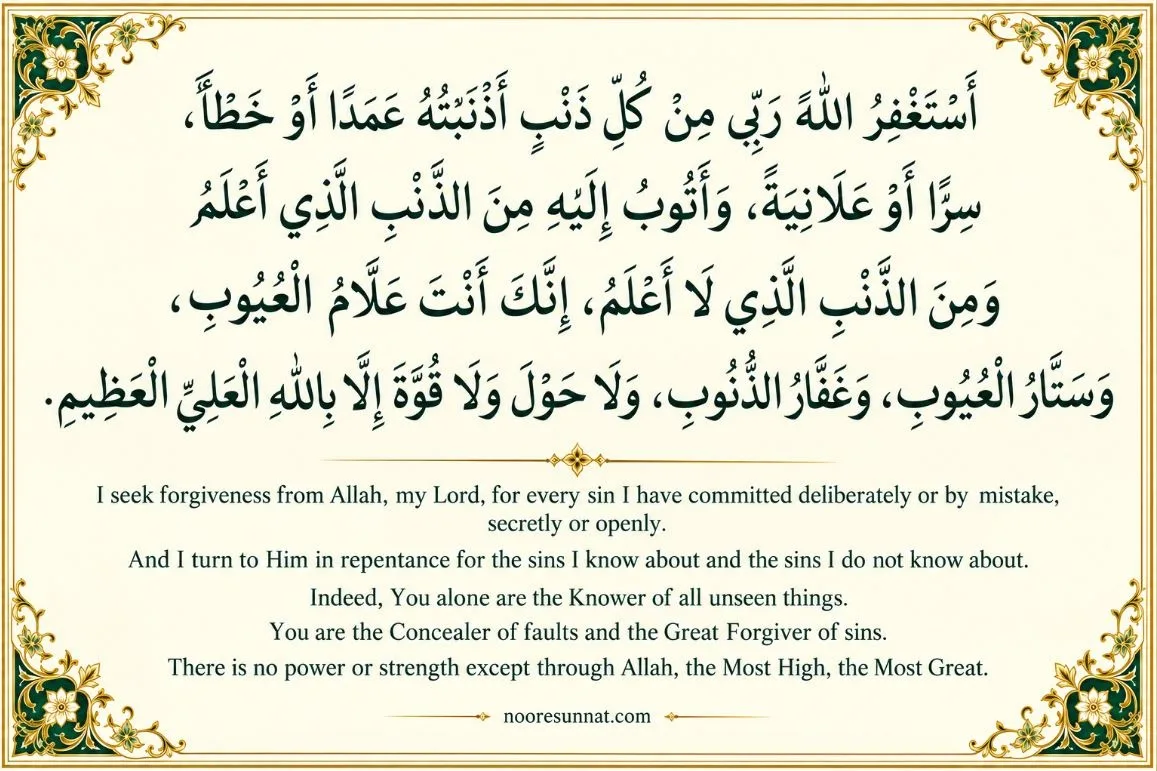
5th Kalma Arabic
أَسْتَغْفِرُ اللّٰهَ رَبِّي مِنْ كُلِّ ذَنْبٍ أَذْنَبْتُهُ عَمْدًا أَوْ خَطَأً، سِرًّا أَوْ عَلَانِيَةً، وَأَتُوبُ إِلَيْهِ مِنَ الذَّنْبِ الَّذِي أَعْلَمُ وَمِنَ الذَّنْبِ الَّذِي لَا أَعْلَمُ، إِنَّكَ أَنْتَ عَلَّامُ الْغُيُوبِ، وَسَتَّارُ الْعُيُوبِ، وَغَفَّارُ الذُّنُوبِ، وَلَا حَوْلَ وَلَا قُوَّةَ إِلَّا بِاللّٰهِ الْعَلِيِّ الْعَظِيمِ.
Transliteration
Astaghfirullāha rabbī min kulli dhanbin adhnabtuhū ‘amadan aw khaṭa’an, sirran aw ‘alāniyatan, wa atūbu ilayhi minadh-dhanbilladhī a‘lamu wa minadh-dhanbilladhī lā a‘lamu, innaka anta ‘allāmul-ghuyūbi, wa sattārul-‘uyūbi, wa ghaffārudh-dhunūbi, wa lā ḥawla wa lā quwwata illā billāhil-‘aliyyil-‘aẓīm.
Panchwa Kalima Urdu Translation
میں اللّٰہ سے، جو میرا رب ہے، اپنے ہر اس گناہ کی معافی مانگتا ہوں جو میں نے جان بوجھ کر یا غلطی سے، چھپ کر یا کھلم کھلا کیا۔
اور میں اس کے حضور توبہ کرتا ہوں، ان گناہوں سے بھی جنہیں میں جانتا ہوں اور ان گناہوں سے بھی جنہیں میں نہیں جانتا۔
بے شک تو ہی پوشیدہ باتوں کو خوب جاننے والا ہے۔
اور عیبوں کو چھپانے والا اور گناہوں کو بہت بخشنے والا ہے۔
اور اللّٰہ کی مدد کے بغیر نہ کوئی طاقت ہے اور نہ قوت، وہی سب سے بلند اور عظمت والا ہے۔
Fifth Kalma English Translation
I seek forgiveness from Allah, my Lord, for every sin I have committed deliberately or by mistake, secretly or openly.
And I turn to Him in repentance for the sins I know about and the sins I do not know about.
Indeed, You alone are the Knower of all unseen things.
You are the Concealer of faults and the Great Forgiver of sins.
There is no power or strength except through Allah, the Most High, the Most Great.
Explanation of the Fifth Kalima
The Fifth Kalima is known as Kalima Astaghfar because it is a prayer for forgiveness and an expression of repentance. Its words teach a Muslim to admit their mistakes, ask Allah for mercy, and turn back to Him with humility. It reminds us that we always need Allah’s forgiveness and help to improve our lives.
The opening words “Astaghfirullāha rabbī” mean that we seek forgiveness from Allah, our Lord. Instead of making excuses or treating our mistakes as unimportant, we acknowledge our need for His mercy. Calling Allah our Lord also reminds us that the One who created and sustains us is the One to whom we return in repentance.
The phrase “Min kulli dhanbin adhnabtuhū ‘amdan aw khaṭa’an” makes this request comprehensive. We ask forgiveness for every sin, whether committed deliberately or through error. These words encourage honest reflection on our conduct, including the mistakes we may have overlooked or failed to take seriously.
The words “Sirran aw ‘alāniyatan” mean secretly or openly. Other people may see only part of our lives, but nothing is hidden from Allah. A believer should therefore care about their private conduct as well as their public behaviour. Our aim should be to please Allah even when nobody else is watching.
The next words ask forgiveness for sins we know about and those we do not know about. We may remember some wrong actions clearly while forgetting others. We may also fail to recognise the hurt caused by a careless remark or an unfair decision. This part of the Kalima teaches humility about our own judgment and shortcomings.
The phrase “Wa atūbu ilayhi” means that we turn to Allah in repentance. Sincere repentance involves more than speaking words: it means leaving the sin, regretting it, and sincerely resolving not to return to it. Where another person’s rights have been violated, we must also take steps to restore those rights.
The words “‘Allāmul-ghuyūb, sattārul-‘uyūb, ghaffārudh-dhunūb” acknowledge that Allah knows all hidden things, conceals faults, and repeatedly forgives sins. They bring together accountability and hope. Allah knows the full truth about us, yet we can still turn to Him and ask for forgiveness.
Finally, “Lā ḥawla wa lā quwwata illā billāh” expresses our dependence upon Allah. We need His help to resist temptation, leave harmful habits, and remain obedient. The Fifth Kalima therefore combines asking for forgiveness with recognising our need for Allah’s strength and guidance.
Virtues of the Fifth Kalima
The Fifth Kalima centres on istighfar, seeking Allah’s forgiveness, and tawbah, turning back to Him in repentance. The references below establish the virtues of these acts generally; they do not prescribe a particular reward or repetition count for this complete wording.
Seeking forgiveness regularly follows the example of Rasulullah ﷺ. In Sahih al-Bukhari 6307, he said that he sought Allah’s forgiveness and turned to Him in repentance more than seventy times a day. His example encourages Muslims to make istighfar a regular part of life.
In Sahih Muslim 2702b, Rasulullah ﷺ encouraged people to repent to Allah and mentioned that he himself repented to Him one hundred times a day. This teaches us to keep returning to Allah instead of waiting for a particular occasion or a major mistake.
Seeking forgiveness also reminds a believer never to lose hope in Allah’s mercy. In Surah Az-Zumar, verse 53, Allah addresses those who have wronged themselves and tells them not to despair of His mercy. The following verse calls them to return to their Lord and submit to Him.
Together, these verses offer hope and invite action through repentance.
Reflecting on the Fifth Kalima can help us examine our behaviour honestly. Its mention of hidden and open wrongdoing encourages us to look beyond appearances. Its mention of known and unknown sins reminds us that we may need forgiveness for more than we remember.
The words also encourage a balance between regret and hope. A Muslim should take wrongdoing seriously while continuing to seek Allah’s mercy. Regret should lead us towards repentance, repairing harm, and better choices.
The Fifth Kalima is a meaningful reminder to return to Allah with sincerity. By understanding its words and acting upon them, a believer can make the request for forgiveness part of a continuing effort to live with greater humility, responsibility, and obedience.
Is the Fifth Kalima Found in Hadith?
The Fifth Kalima is not found in one single hadith in its complete, commonly taught wording. However, its words were gathered from supplications recorded in different ahadith.
Scholars brought these expressions together to help ordinary Muslims learn, remember, and recite a comprehensive prayer of forgiveness.
These supplications include asking Allah to forgive hidden and open wrongdoing, deliberate mistakes and unintentional errors, and matters known and unknown to us. They also include acknowledging Allah’s knowledge of the unseen and our dependence upon His power and help.
The Fifth Kalima should therefore be understood as a scholarly compilation drawn from hadith supplications, rather than one complete supplication narrated word for word from Rasulullah ﷺ.
The virtues of seeking forgiveness and repentance apply generally, while any specific reward or prescribed repetition count needs evidence relating to the particular wording concerned.
Related Links
Have a question or thought about this bayan?
Leave a comment below. All comments are reviewed before appearing.
Related Reading
Popular Audios
- Durood e Ibrahimi - The Best Darood Sharif (Urdu & Eng Translation) 123,001 listeners
- Eid ul Fitr & Adha Takbeer Full | Allahu Akbar Kabira MP3 Audio 111,728 listeners
- Hajj and Umrah Talbiyah - Labbaik Allahumma Labbaik Audio MP3 (Translation) 71,850 listeners
- Takbeer e Tashreeq Audio (9 to 13 Zul Hijjah) 23,984 listeners
- Dua for Anxiety, Depression, Debt Relief - Allahumma inni auzubika minal hammi wal hazan 19,613 listeners
- Dua After Azan With English and Urdu Translation 16,341 listeners